 Sajeeb Sarker
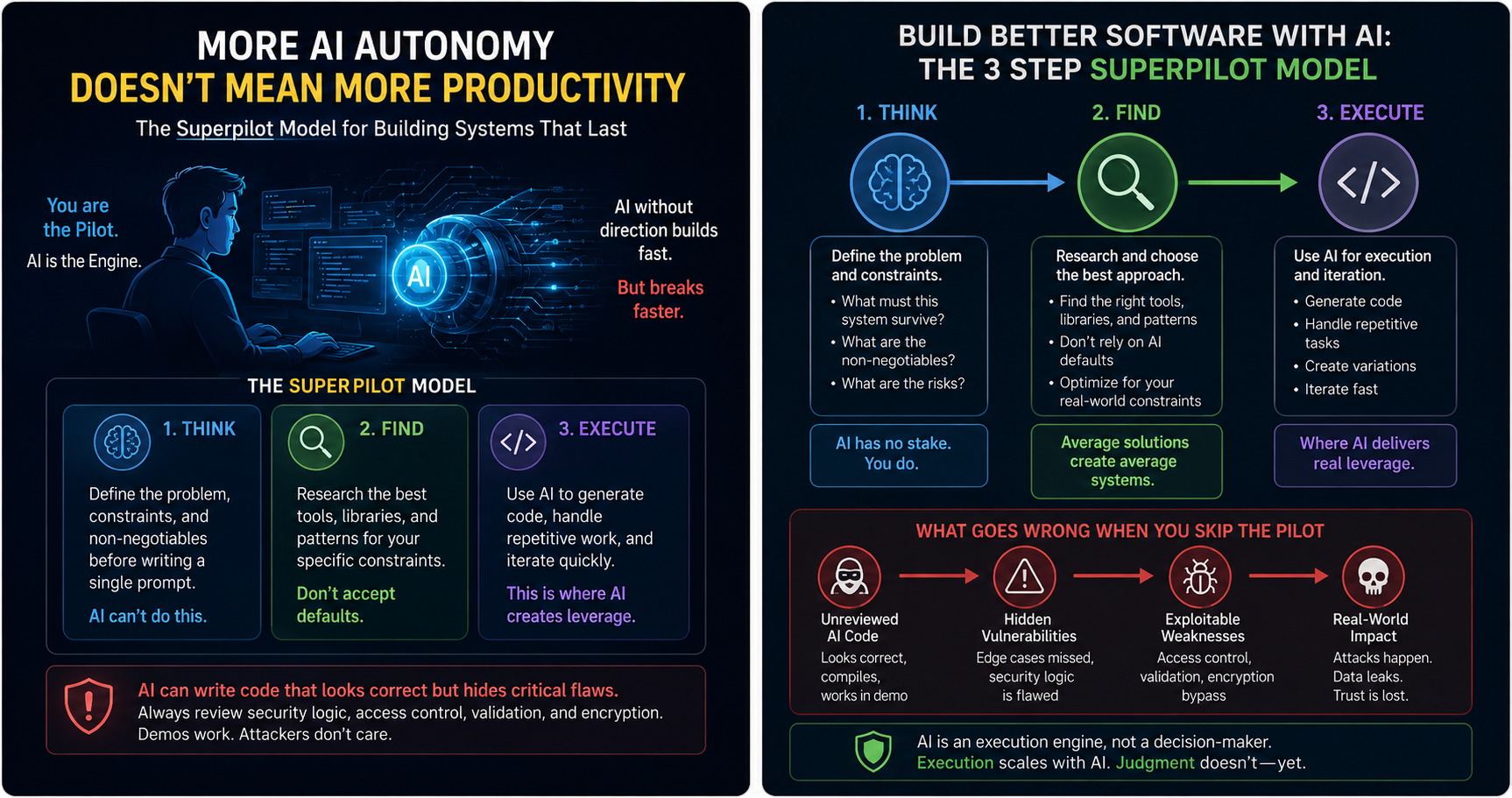
There's a growing assumption in software development that more AI autonomy equals more productivity. Let the model decide the architecture. Let it choose the dependencies. Let it write the security logic unsupervised. In our research and hands-on work building production systems, we found the opposite is true for anything meant to last. We call our approach the superpilot model. The person retains ownership of every architectural, security, and business decision. AI tools are treated strictly as execution engines, not decision-makers. This isn't a philosophical stance; it came from watching where AI-generated code actually fails. The pattern breaks down into three repeatable steps: Think, Find, Execute. Think means defining the problem and constraints before any prompt is written. What does this system need to survive contact with real users, real traffic, and real attackers? What are the non-negotiables? AI cannot do this step, because it has no stake in the outcome and no persistent memory of why a decision mattered. Find means researching the actual best tool, library, or pattern for the constraints defined in step one, rather than accepting whatever an AI model defaults to. Default suggestions are trained on average use cases. Production systems rarely are average. Execute is where AI earns its place. Once the architecture is set and the approach is chosen, AI models are excellent at producing code quickly, generating variations, and handling repetitive implementation work. This is where the leverage actually lives. What we found in practice: AI-written code that skips human review on security-relevant logic tends to look correct while missing edge cases that only show up under adversarial conditions. Access control, encrypted middleware, and validation logic are where this shows up most. The code compiles, the demo works, and the vulnerability sits there until someone tests for it deliberately. The takeaway for anyone building with AI tools today isn't to avoid them. It's to be precise about which decisions you're willing to hand over and which ones you're not. Execution scales with AI. Judgment doesn't, ye
TechnologySoftware DevelopmentProgrammingDeveloper ToolsCodingComputer ScienceTech TrendsDigital TechnologyArtificial IntelligenceMachine LearningDeep LearningAI ToolsNeural NetworksGenerative AILLM#Tech#Software#Programming#Developer#Coding#TechTrends#DigitalTech#ComputerScience#AI#MachineLearning
The Superpilot Model: Why AI Orchestration Beats AI Delegati
Most teams hand decisions to AI and hope for the best. We researched a different model: humans own architecture, security, and judgment while AI handles execution. Here's what a year of applying "Think, Find, Execute" across real client builds taught us about where AI genuinely helps and where it quietly introduces ris
By Sajeeb Sarker
•
2026-08-03
•
🕐 2 min read
•
333 words
External Resource
Visit Li →
Be the first to leave a comment!